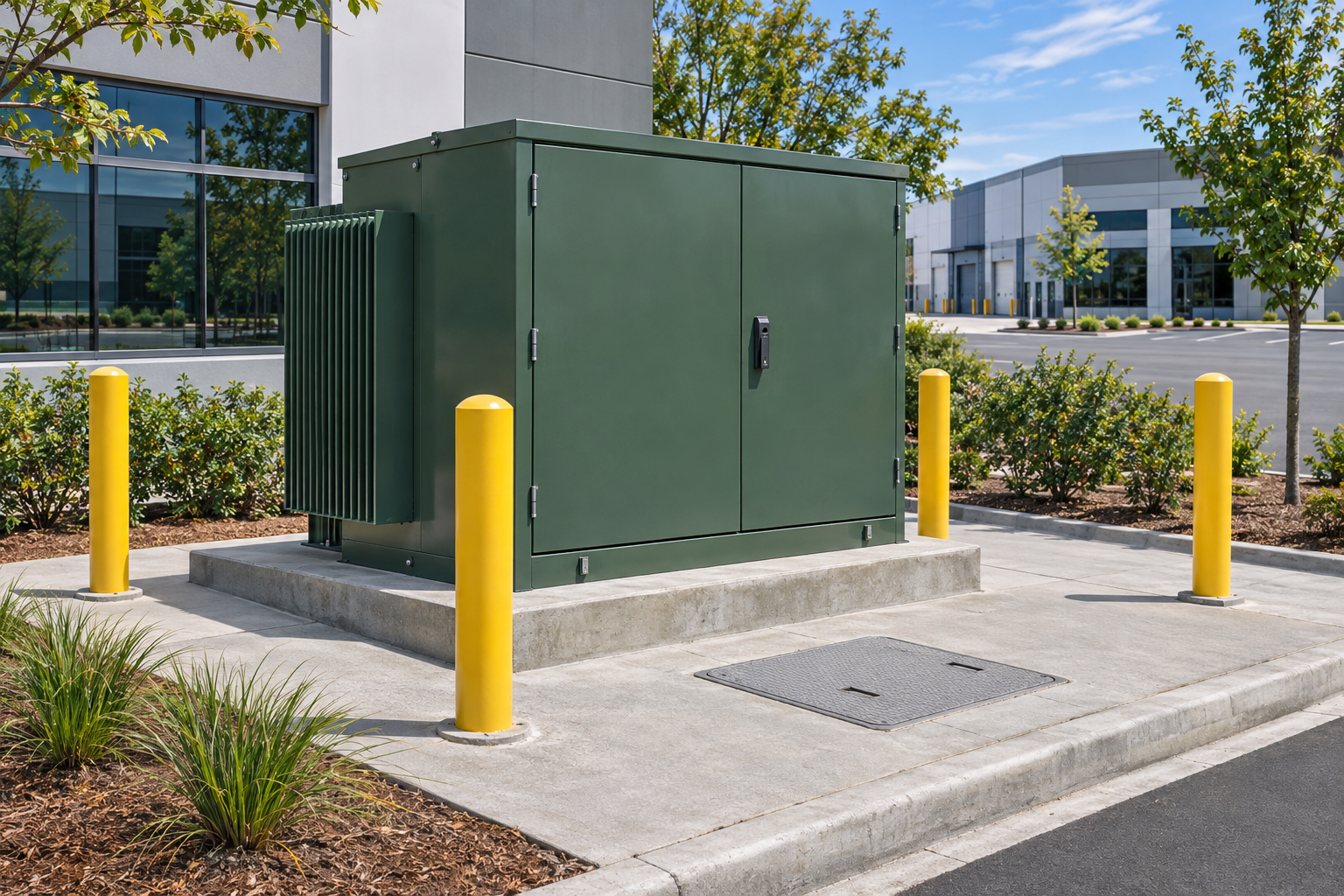
Pad-mounted transformers are widely used where commercial and industrial campuses distribute medium-voltage power through underground cables. Their enclosed construction supports ground-level operation, but the surrounding civil layout determines whether installation, inspection and replacement can be performed safely.
A successful layout connects electrical ratings with traffic protection, cable routing, drainage, security and utility access. These decisions should be settled before the foundation and underground duct bank are poured.
Start with Feed Arrangement and Service Access
The team should confirm radial or loop feed, live-front or dead-front terminations, switching requirements and the side from which technicians will operate the cabinet. Door swing and working space must remain clear after landscaping, fences and parking spaces are installed.
Replacement planning matters as much as routine access. The route must support a delivery vehicle, lifting equipment and removal of the complete transformer without demolishing permanent site features.
Campus Layout Checklist
Coordinate the concrete pad, anchoring, grounding grid and finished grade with the approved transformer drawing.
Protect the enclosure from vehicles with correctly positioned bollards that do not block doors or lifting access.
Keep stormwater, irrigation and roof drainage away from cable compartments and the transformer foundation.
Separate primary and secondary duct banks and respect cable bending radius at every termination.
Preserve ventilation openings, oil-containment provisions and required clearances from buildings and combustible materials.
Reserve space for future feeders or a higher-capacity replacement when campus load growth is expected.
Match the Transformer to the Campus Load
Commercial campuses often combine HVAC, elevators, lighting electronics, EV charging, workshops and office loads. Diversity can reduce coincident demand, while motor starting and rapid charging can create short-duration voltage-drop concerns.
The specification should define kVA, voltage ratio, impedance, tap range, efficiency, sound level, protection and the required cable interfaces. A coordinated load study gives the manufacturer enough information to select the enclosure and internal arrangement correctly.
Next Step
For outdoor underground distribution, SOVIN’s ZGS Serisi II zemin tipi transformatör can be configured around the required voltage, capacity and feed arrangement. Share the single-line diagram and site plan before civil work is released.
Technical reference: IEEE C57.12 series requirements and the applicable local utility construction standard.
Doğru dağıtım çözümünü seçmek için, zemine monte ve direğe monte transformatörleri kurulum, güvenlik, kapasite, bakım ve uygulama açısından karşılaştırın.
Fast-charging networks are increasing both the number and the power rating of public charging points. The International Energy Agency’s Global EV Outlook 2026 reports that fast and ultra-fast chargers grew from 1.5 million in 2024 to 2.2 million i...
2026 yılında yapay zeka ve veri merkezlerinin büyümesi elektrik talebini artırmaktadır. Transformatör kapasitesi, orta gerilim şalt sistemleri, koruma koordinasyonu ve esnek dağıtım planlamasının güvenilir elektrik sistemlerini nasıl desteklediğini öğrenin.
2026 yılında da transformatör teslim süreleri ve şebeke tedarik zincirleri önemini korumaktadır. Alıcıların sipariş vermeden önce doğrulamaları gereken elektriksel değerleri, kurulum koşullarını, verimliliği, sertifikaları ve belgeleri gözden geçirin.
 Öne Çıkan Kategoriler













Ürün Sorgusu Gönder
24 saat içinde sizinle iletişime geçeceğiz